
In industrial level measurement, Guided Wave Radar and Non-Contact Radar are often used in similar applications.
However, many problems such as unstable level signals, false alarms, or fluctuating measurements are not caused by poor instrument quality, they are caused by selecting the wrong measurement principle from the beginning.
Although both technologies belong to radar level measurement, their working methods, application suitability, and long-term maintenance characteristics are very different.
This article compares Guided Wave Radar and Non-Contact Radar from an engineering application perspective rather than simply comparing product specifications.
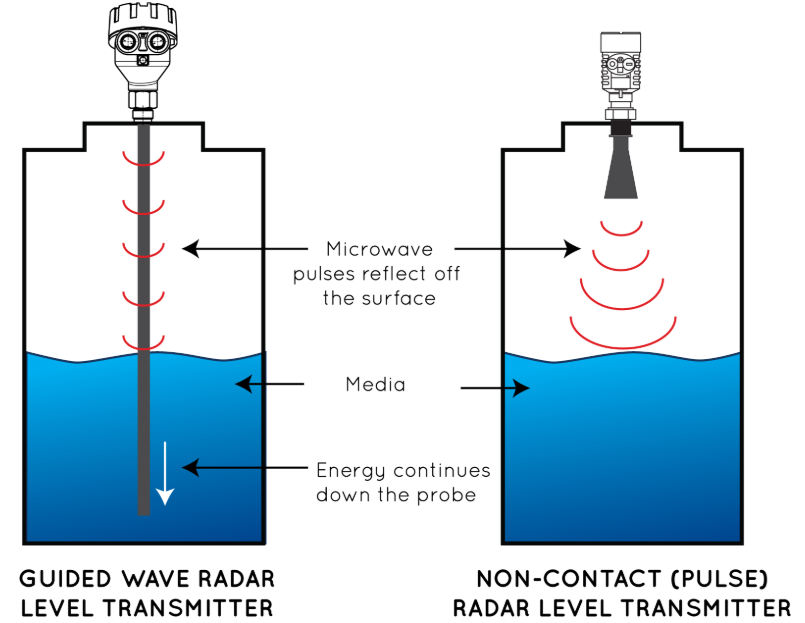
What Is the Main Difference Between Guided Wave Radar and Non-Contact Radar?
The easiest way to understand the difference is:
- Guided Wave Radar sends microwave signals along a probe or cable.
- Non-Contact Radar sends microwave signals freely through the air.
This means:
Guided Wave Radar has a more controlled signal path, while Non-Contact Radar depends more on the surrounding tank environment.
Guided Wave Radar vs Non-Contact Radar: Key Comparison Table
| Comparison Item | Guided Wave Radar | Non-Contact Radar |
|---|---|---|
| Contact with medium | Yes | No |
| Installation method | Requires probe or cable | Top mounting only |
| Resistance to internal structure interference | Strong | Moderate |
| Performance in small tanks | Excellent | Moderate |
| Stability in agitated applications | More stable | More affected by turbulence |
| Foam resistance | Better | More sensitive |
| Steam resistance | Moderate | Improved significantly with 80GHz radar |
| High-viscosity media | Probe buildup possible | More suitable |
| Corrosive media | Probe material must be considered | Better choice |
| Long measurement range | Limited by probe length | More suitable |
| Hygienic applications | Less common | More common |
| Maintenance requirements | Higher | Lower |
When Should You Choose Guided Wave Radar?
Guided Wave Radar is usually a better choice for the following situations:
1. Small or Narrow Tanks
Because the signal travels along the probe, it is less affected by tank wall reflections.
2. Tanks with Complex Internal Structures
For example:
- Agitators
- Heating coils
- Support structures
Guided Wave Radar can reduce false echoes more effectively.
3. Media with Weak Reflection Capability
Some liquids naturally produce weak radar reflections.
In these cases, Guided Wave Radar usually provides more stable measurements.
4. Interface Measurement
For example:
Oil-water interface measurement.
Guided Wave Radar is often better at detecting different liquid layers.
When Should You Choose Non-Contact Radar?
1. Corrosive Media
Since the sensor does not directly contact the liquid, maintenance risks are lower.
2. Sticky or Heavy Buildup Applications
For example:
- Sludge
- Asphalt
- High-viscosity slurry
Material buildup on the probe can affect Guided Wave Radar performance.
3. Large Storage Tanks
Very long probes become difficult to install and maintain.
Non-Contact Radar is usually more suitable for large tanks.
4. Food, Beverage, and Pharmaceutical Industries
Many hygienic applications prefer measurement technologies with minimal contact with the product.
Why Are 80GHz Radar Sensors Becoming More Popular?
One of the biggest disadvantages of early Non-Contact Radar systems was the wide beam angle.
This often caused:
- Tank wall reflections
- Interference from internal structures
- False echoes
However, 80GHz radar technology provides a much narrower beam angle.
As a result:
- Signal focusing is more precise
- Interference is reduced
- Measurement stability is improved
Today, many applications that previously required Guided Wave Radar can now successfully use 80GHz Non-Contact Radar.
Especially in:
- Medium and small tanks
- Chemical process vessels
- Light steam environments
- Applications with moderate foam
80GHz radar performance has improved significantly.
In Many Cases, Installation Is More Important Than the Instrument Itself
One of the most overlooked issues in level measurement is improper installation.
Many people assume:
“Unstable signal = poor instrument quality.”
But in reality, incorrect installation can cause problems even with high-end radar sensors.
For example:
| Incorrect Installation | Possible Result |
|---|---|
| Near the inlet | Severe level fluctuation |
| Facing the agitator | Signal jumping |
| Too close to the tank wall | False echoes |
| Excessively long mounting nozzle | Signal attenuation |
| Condensation on antenna | Unstable echoes |
In many applications, stable measurement is achieved not by changing the instrument brand, but by optimizing the installation position.
Final Thoughts
If your priority is:
- Stability in small spaces
- Complex internal structures
- Interface measurement
Guided Wave Radar is often the better choice.
If your priority is:
- Lower maintenance
- Corrosive applications
- Large storage tanks
- Hygienic processes
Non-Contact Radar is usually more suitable.
The best level measurement solution is not necessarily the most expensive one.
It is the technology that best matches the actual process conditions.
Need Help Selecting the Right Radar Level Measurement Solution?
Every application is different.
Tank size, vapor, foam, agitation, buildup, corrosion, and installation position can all affect long-term measurement stability.
Choosing between Guided Wave Radar and Non-Contact Radar is not only about product price — it is about selecting the most reliable measuring principle for your actual process conditions.
At Antlets, we help customers select suitable level measurement solutions for:
- Water & wastewater
- Chemical processing
- Food & beverage
- Oil & fuel storage
- Mixing tanks
- High-temperature and corrosive applications
If you are experiencing unstable level signals, false echoes, or difficult installation conditions, feel free to contact us for application support and model recommendations.
info@antletstech.com +86 132 7933 7527