
Temperature measurement might seem simple at first glance, but in real industrial environments it can be surprisingly complex. Most users may recognize a product configuration page with options like Approval, Housing, Sensor Type, etc., but these are just UI elements — the real decision logic is behind them.
Industrial temperature measurement isn’t about filling in a form — it’s about answering these fundamental engineering questions:
👉 What are the process conditions?
👉 Which sensing principle matches those conditions?
👉 How should the sensor be protaected and installed?
👉 How will the signal integrate with control systems?
Answering these allows engineers to create reliable, durable temperature measurement solutions.
1. Start with Process Conditions
Before choosing a temperature instrument, the first and most important step is understanding the process itself:
- What medium are we measuring (gas, liquid, solid)?
- What is the temperature range?
- Are there corrosive chemicals?
- Is the environment high-pressure or high-flow?
- Is vibration present?
- Does the measurement point lie within a hazardous area?
These real conditions determine how robust and precise the final solution needs to be. You can’t choose a sensor based on the nameplate alone — it has to match the actual environment.
2. Choose the Right Sensing Technology
In industrial temperature measurement, the two most commonly used sensing technologies are:
Thermocouples
Thermocouples work by generating a small voltage between two dissimilar metals when there’s a temperature difference — this is known as the Seebeck effect. (See temperature measurement principle for detailed explanation.)Thermocouples are rugged, simple, and can measure a very wide temperature range.
- Strengths: Very wide temperature range, fast response, good mechanical ruggedness, compatible with harsh environments.
- Typical applications: furnaces, steam lines, turbines, high-temperature industrial zones.
RTDs (Resistance Temperature Detectors)
RTDs measure temperature by detecting changes in electrical resistance of a metal (often platinum). They are widely used when precision and long-term stability are priorities.
- Strengths: Higher accuracy and stability than thermocouples.
- Typical applications: chemical reactors, laboratory environments, precision control systems.
Quick Comparison
| Feature | Thermocouple | RTD |
|---|---|---|
| Temperature Range | Very wide | Moderate |
| Accuracy | Moderate | High |
| Stability | Moderate | Very high |
| Response Time | Fast | Medium |
The choice between these is the first major decision point in selecting a temperature measurement solution.
3. Mechanical Protection and Installation
Once the sensing principle is determined, the next question is how to place it in the process.
Protective Tubes (Thermowells)
In most industrial installations the sensor is placed inside a protective tube called a thermowell. The purpose of a thermowell is to:
- Protect the sensor from corrosive or erosive media
- Allow maintenance without breaking process seals
- Shield the sensor from mechanical impacts
Appropriate thermowell design improves longevity and reduces the risk of field failures.
Insertion Depth and Positioning
For accurate measurement, the sensor must reach the region of the process where the temperature reading is truly representative of the medium, not influenced by pipe walls or boundary layers.
A general engineering rule is:
The sensor tip should be inserted far enough into the medium to minimize boundary layer effects.
This relates directly to how field installation and process connections are engineered.
4. Output Signals and Integration
After choosing the sensor and installing it correctly, the next concern is how to get the temperature reading into the control system.
- Standard analog signal (4–20 mA)
- Digital protocols (e.g., HART, Modbus, Profibus)
These signal options are what configuration pages label as Communication, but in engineering terms they ensure the temperature data can be used reliably by a PLC, DCS, or SCADA system.
5. Safety and Environmental Compliance
In some industrial environments, the sensor must meet specific certifications:
- Explosion-proof / hazardous area approvals
- NEMA/IP enclosure ratings
- Sanitary design for food / pharmaceutical applications
These requirements are about safety and compliance, and must be validated before installation.
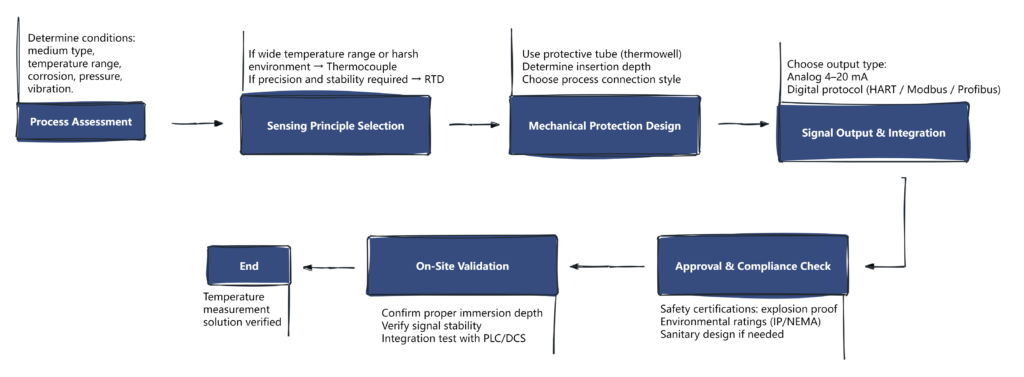
6. A Practical Selection Checklist
To help engineers and technical readers apply this logic, here’s a practical selection sequence:
- Define the process conditions — temperature range, medium, pressure, corrosion, vibration.
- Pick the temperature sensing technology (thermocouple or RTD) based on range and precision needs.
- Design mechanical protection (thermowell / protective tube) suited to the environment.
- Choose installation method — process connections and insertion depth.
- Select output and communication format for system integration.
- Check safety and compliance certifications required for the location.
- Validate on site — confirm immersion, signal stability, and integration with controllers.
This process ensures that temperature measurement is not just accurate, but also reliable in the long term.
Engineering Insight
Industrial temperature measurement is not about ticking boxes on a form — it’s about matching a measurement solution to real physical conditions and long-term operational requirements. That’s why understanding the principle behind sensors and how they interact with the process is crucial for robust engineering results.
– – – – – – – – – – – – – – – – – – – – – – – – – – – – – – – – – – – – – – – – – – – – – – – – – – – – – – – – – – – – – – – – – – – – – – – – – –
For detailed technical specifications, application advice, or commercial inquiries regarding a wider range of industry brands, please contact us via WhatsApp: +86 132 7933 7527 or Email: info@antletstech.com. Our experienced engineering team is ready to support your project.