
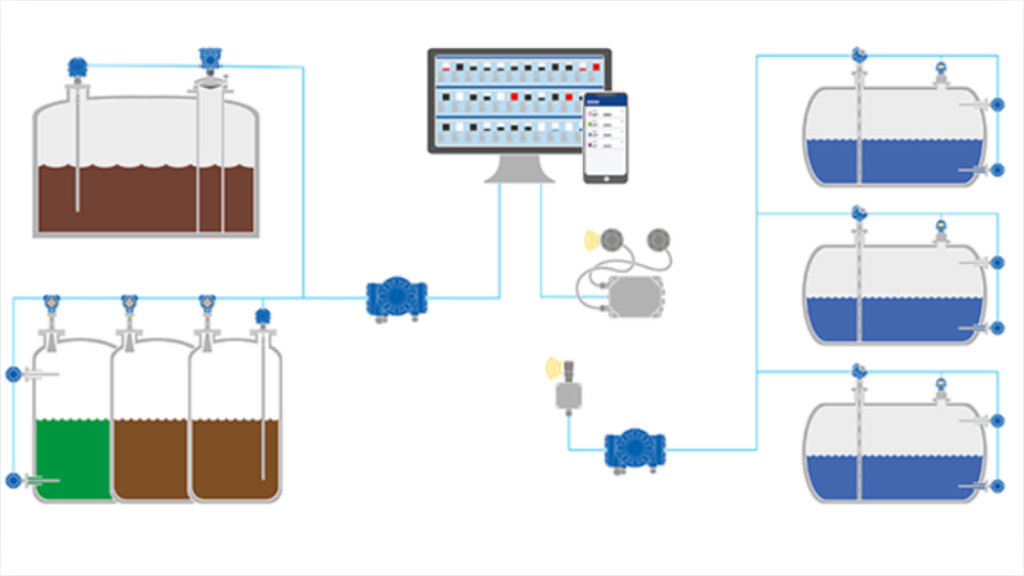
Level is one of the most intuitive and commonly monitored parameters in industrial process measurement. In industries such as water and wastewater treatment, chemical processing, oil and gas, power generation, and food and beverage, level measurement is directly linked to material balance, equipment safety, and stable continuous operation.
Similar to temperature and pressure, the essence of level measurement does not lie in the instrument itself, but in understanding how liquids behave under the combined influence of gravity, pressure, and physical space.
1. What Is Level Measurement
Level describes the height or position of a liquid within a vessel, pipeline, or open space. At its core, it answers a very simple question:
Where is the liquid level right now?
In industrial applications, level measurement is commonly used to:
- Prevent tank overflow or dry running
- Maintain stable process conditions
- Enable continuous or batch process control
It is important to note that level is not a point-based physical quantity. Instead, it represents the geometric state of a liquid in space, which means it cannot be measured directly.
2. Why Level Cannot Be Measured Directly
Under real operating conditions, there is no direct way to “read” the height of a liquid. The existence of level depends on several factors, including:
- The effect of gravity
- The structure of the vessel or container
- The physical properties of the liquid itself
As a result, level measurement is always achieved indirectly, by observing other physical phenomena caused by changes in liquid level, such as:
- Variations in hydrostatic pressure
- Changes in position where the liquid contacts solids or gases
- The interaction of the liquid with external signals such as sound, light, or electric fields
All level measurement methods are essentially different implementations of this indirect measurement approach.
3. Fundamental Physical Principles Behind Level Measurement
Although industrial level measurement methods vary widely, their underlying physical principles are relatively straightforward and can be grouped into several main categories.
3.1 Level vs. Hydrostatic Pressure
Within a gravitational field, the static pressure inside a liquid increases as the liquid level rises. In simple terms:
The deeper the liquid, the greater the pressure at the bottom.
When the liquid density and gravitational acceleration are known, measuring the pressure at the bottom or at a defined point allows the liquid level to be calculated indirectly.
This principle is applicable to both open and closed vessels and forms the basis of many level measurement concepts.
3.2 Level vs. Geometric Position
In many applications, level can be understood as the position of the liquid surface relative to a reference point.
As the liquid rises or falls, its surface passes through specific height positions. By detecting whether the liquid has reached a certain point, or by continuously tracking the position of the liquid surface, the level can be determined.
This geometry-based perspective is especially common in storage tanks, basins, and open-channel systems.
3.3 Level vs. Buoyancy
When an object is immersed in a liquid, it experiences an upward buoyant force. The magnitude of this force is directly related to the volume of liquid displaced.
As the liquid level changes, the immersed state of the object changes accordingly. This variation in buoyant force provides another fundamental way to understand and infer liquid level.
3.4 Level vs. Medium Properties
Liquid properties such as density, dielectric constant, and electrical conductivity influence how level changes manifest in physical signals.
Because different liquids exhibit different physical characteristics, level measurement in industrial applications must always be considered in relation to the specific properties of the medium being measured.
4. Basic Requirements for Level Measurement Principles in Industrial Applications
In industrial environments, level measurement principles are generally expected to meet the following requirements:
- Accurately reflect real level changes
- Adapt to varying process conditions
- Provide stable and repeatable measurement results
- Integrate reliably with control and safety systems
For this reason, engineers evaluating level measurement principles focus not only on whether a level can be measured, but also on the conditions under which the measurement remains reliable.
5. Summary
At its core, level measurement is the process of converting the height of a liquid—shaped by gravity and physical space—into a physical quantity that can be observed and evaluated. Whether based on pressure, position, buoyancy, or medium properties, all level measurement concepts ultimately trace back to fundamental physical laws.
A clear understanding of these principles provides a solid foundation for later decisions involving level measurement methods, instrument application, and on-site problem analysis.In many industrial systems, level measurement is closely related to pressure and flow monitoring.
– – – – – – – – – – – – – – – – – – – – – – – – – – – – – – – – – – – – – – – – – – – – – – – – – – – – – – – – – – – – – – – – – – – – – – – – – –
For detailed technical specifications, application advice, or commercial inquiries regarding a wider range of industry brands, please contact us via WhatsApp: +86 132 7933 7527 or Email: info@antletstech.com. Our experienced engineering team is ready to support your project.