
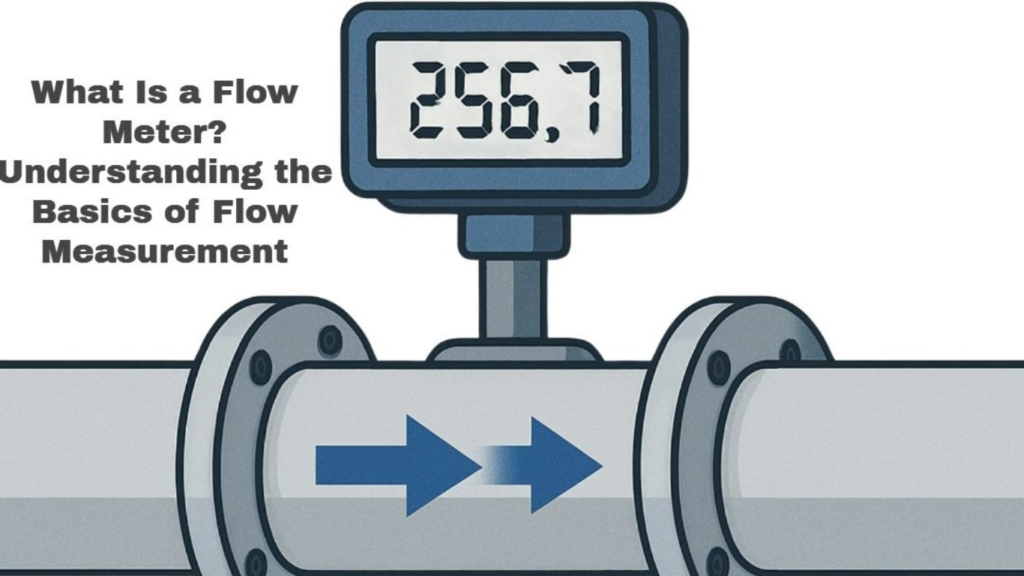
Flow measurement is essentially about understanding how much fluid moves from one place to another. This article focuses on two fundamental questions: why flow can be measured, and which physical principles make flow measurement possible.
At its most basic level, flow measurement answers a very simple question: how fast is a fluid moving, and how much passes through a given point over time? Whether the fluid is water, air, steam, or oil, the underlying principles remain the same.
What Is Flow?
Flow describes the movement of a fluid over a unit of time. It is commonly classified into the following types:
- Volumetric flow: describes the volume of space occupied by a moving fluid, such as cubic meters per hour.
- Mass flow: describes the actual amount of matter passing through a system per unit time, independent of volume.
Over the same period of time, a wide river flowing slowly and a narrow pipe with high velocity may transport the same amount of fluid. This illustrates that flow is not determined by velocity alone, but also depends on cross-sectional area and fluid properties.
Why Flow Cannot Be Measured Directly
Unlike temperature or pressure, flow is not a physical quantity that exists at a single point. It only exists when a fluid is in motion and always involves both distance and time.
For this reason, flow cannot be “measured directly” in the same way as temperature. In practice, flow is determined by observing other physical changes caused by fluid motion and using them to infer the flow rate.
All flow measurement methods are, in essence, applications of this indirect measurement approach.
Fundamental Physical Principles Behind Flow Measurement
Although there are many ways to describe and determine flow, they all originate from a small number of basic physical concepts.
Relationship Between Flow and Pressure
When a fluid passes through a constricted section of a pipe or a narrow passage, its velocity increases while static pressure decreases. This relationship between pressure and velocity is one of the most fundamental and classical principles used in flow measurement.
By observing pressure differences at different locations, the flow rate can be determined.
Relationship Between Flow and Velocity
If the average velocity of a fluid is known, and the cross-sectional area through which it flows is also known, the flow rate can be calculated.
This concept applies not only to closed pipelines but also to natural flow scenarios such as rivers and open channels.
Relationship Between Flow and Mass
In some cases, volume alone does not fully describe fluid behavior. Changes in temperature and pressure can cause fluids to expand, compress, or vary in density.
Mass flow focuses on the amount of matter passing through a system per unit time and is not directly affected by these changes. Based on the principle of mass conservation, mass flow is especially meaningful in systems with varying operating conditions.
Relationship Between Flow and Heat Transfer
When a fluid passes a heat source, it carries heat away. In general, the faster the fluid moves, the more heat it can transport over a given period of time.
This relationship between flow and heat transfer provides another way to understand and estimate flow behavior, particularly in gas flow situations.
Flow as a Physical Concept
At its core, flow measurement is an application of fundamental physical laws to real-world phenomena. It connects motion, energy, pressure, and heat into a quantity that can be observed and calculated.
Understanding these basic principles helps explain why flow can be described in many different ways, and why all of them ultimately trace back to the same physical foundations.
And see how flow measurement is applied in real industries:
– – – – – – – – – – – – – – – – – – – – – – – – – – – – – – – – – – – – – – – – – – – – – – – – – – – – – – – – – – – – – – – – – – – – – – –
For detailed technical specifications, application advice, or commercial inquiries regarding a wider range of industry brands, please contact us via WhatsApp: +86 132 7933 7527 or Email: info@antletstech.com. Our experienced engineering team is ready to support your project.